Owner & Investor Reporting Automation
A value-add multifamily property loses 15 percent of its occupancy in week one. The investors find out in week five, when the month-end statement finally lands in their inbox.
That five-week lag is the problem this workflow closes. Rent roll, income and expense data, occupancy, and maintenance activity pull from your property management and accounting systems continuously instead of once a month. Reports build to each owner's expected layout on their own cadence, and owners and investors get a live portal, so the routine "how is my property doing" question gets answered before it turns into a phone call.
Why Month-End Reporting Is Always an Autopsy, Never a Live Read
For most property management firms and mid-market sponsors, reporting runs on a strict month-end close. The accounting team exports rent rolls, maintenance invoices, and CapEx receipts from the property management system, cross-checks bank statements against the property ledger by hand in Excel, and for syndicated deals runs a separate waterfall model to calculate each investor's tiered payout against their IRR hurdle. An asset manager reviews the numbers, writes the narrative explaining why NOI dipped, and the whole packet goes out as a PDF. That cycle commonly runs well into the second week after the period closes, and every one of those days is a day investors are reading numbers that are already stale.
The lag is the actual problem, not the manual labor underneath it. When occupancy drops or a major repair hits in week one, the investor does not hear about it until the statement arrives in week five. In that gap the report is an autopsy, explaining what already happened, rather than a live read of what is happening now. Anxious investors fill the gap by calling and emailing mid-month for status, cash-flow projections, and maintenance detail, which pulls your asset management team off strategic work to dig through siloed systems and answer one-off questions the standing report should already have covered.
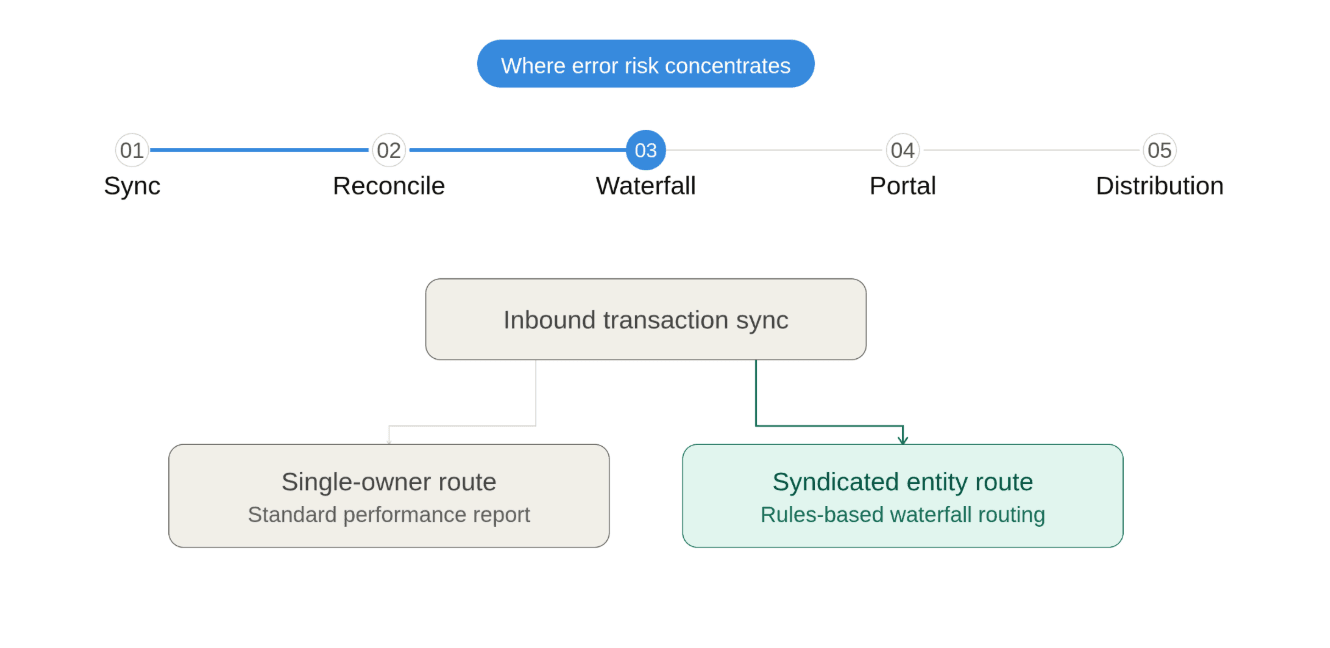
The risk concentrates in the waterfall itself. A single data-entry error in a multi-tier distribution spreadsheet does not just produce an awkward correction. It produces an incorrect payment to an investor, which damages trust on contact and can trigger a compliance review no matter how innocent the mistake was.
The cost lands in three places. Investors lose confidence, not because the property underperformed, but because they learned about a problem weeks after it started. Asset managers get pulled off strategic work to answer mid-month questions a real-time view would have already settled. And a manual waterfall carries a standing risk of a distribution error that costs trust immediately and exposes the GP to a compliance question.
How Flowlyn Closes The Reporting Lag
Continuous Transaction Sync, Not a Month-End Export
Instead of exporting CSVs once a month, Flowlyn connects to your accounting platform and bank feed so transactions sync as they post. Standard maintenance and operating expenses match against the property ledger continuously, which turns a reconciliation that used to consume the first half of the month into something already current by the time the period closes.
Interactive Visualization
Owner-Specific Report Formatting
Each owner's report is built to their expected layout and level of detail, configured once during setup rather than rebuilt by hand every period. An owner who wants a one-page summary gets that. An owner who wants a full income statement with a prior-period comparison gets that, both drawn from the same continuously synced data.
Interactive Visualization
Rules-Based Waterfall Calculation
The exact split terms from your operating agreement, the GP and LP tiers, the preferred return threshold, the IRR hurdles, are configured once as rules instead of rebuilt in a spreadsheet for every distribution. When a distribution event triggers, the system calculates each investor's payout against those rules automatically, which removes the single-cell error that turns one keystroke into an incorrect payment and a compliance question.
Interactive Visualization
Live Owner and Investor Portal
Current rent collection, occupancy, CapEx spend, and recent maintenance activity update in a self-service portal in near real time. An owner or investor checking on performance is not waiting for the next statement and is not calling your office. They get the live read a monthly PDF cannot give them.
Interactive Visualization
Narrative Review, Not Narrative Automation
Flowlyn surfaces the variances that actually need explaining, a utility spike, an occupancy shift, an unusual CapEx item, pulled straight from the data and flagged for your asset manager. Your team writes and owns the explanation that goes to investors. Flowlyn does the digging to find what changed and why it might matter; the judgment on how to frame a sensitive number for an investor relationship stays with a person, which is exactly where it belongs.
Interactive Visualization
What Each Owner and Investor Actually Receives
The same underlying data feeds very different outputs, which is what lets one workflow serve a single owner and a thirty-investor syndication without rebuilding anything.
| Recipient | What they receive |
|---|---|
Single-owner property | A standard performance report, rent roll, income statement, occupancy, and a maintenance summary, in that owner's preferred layout and cadence |
Syndicated or multi-investor entity | Capital account statements, distribution notices, and year-end K-1 routing, built on top of the same financials and governed by the waterfall rules |
Any owner or investor, between reports | Live portal access to current rent collection, occupancy, CapEx, and maintenance status, so routine questions never become a phone call |
Today vs Flowlyn
Today
- Transactions exported once a month and reconciled by hand against the property ledger in Excel, a close that runs into the second week
- Waterfall distributions calculated in a multi-tier spreadsheet, where one data-entry error produces an incorrect investor payment
- Investors learn about an occupancy drop or major repair five weeks later, when the statement arrives
- Asset managers pulled off strategic work to field mid-month "how's it going" calls
- Report narratives written from scratch each period, explaining variances after the fact
With Flowlyn
- Transactions sync continuously from your accounting platform and bank feed, already reconciled by the time the period closes
- Distribution splits calculated automatically against the rules in your operating agreement, removing the single-cell error risk
- Live portal shows current occupancy, rent collection, and maintenance activity as it happens
- Owners and investors get the live read themselves through the portal, without having to ask
- Variances flagged automatically for the asset manager to review and explain, with the supporting data already assembled
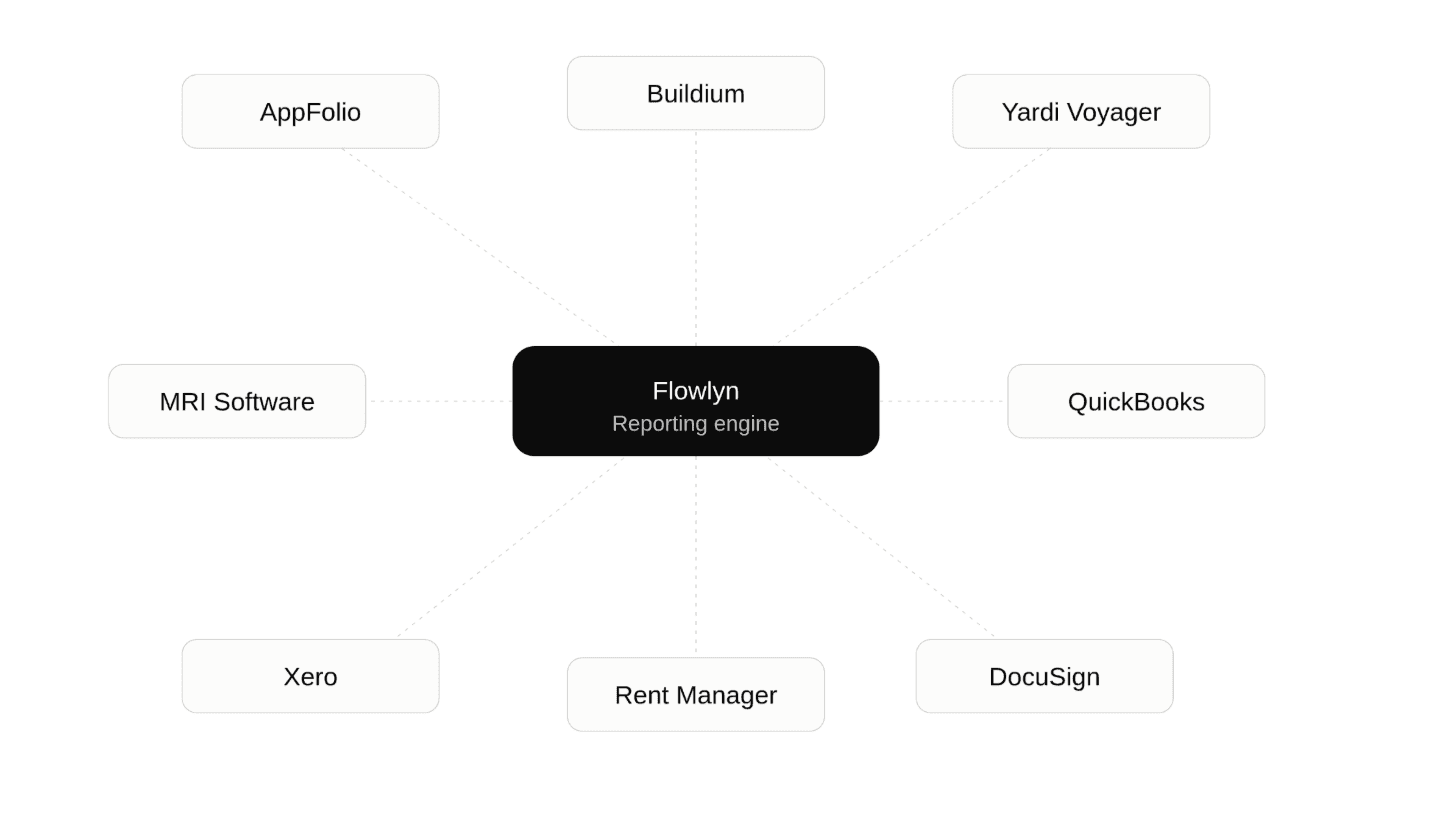
Where the Data Comes From
Property Management Systems
Accounting and Financial
Investor Reporting and Fund Platforms
Communication and Delivery
Document Generation
Whether This Fits Your Reporting Workload
The firms that get the most from this are the ones where reporting quietly eats a piece of every period and where an owner's or investor's confidence rides on getting it right. A real owner base across fifty units or more, a month-end close that swallows the first stretch of every month, mid-month calls for updates, a syndication whose waterfall still lives in a spreadsheet, any one of those is the signal.
A few properties for a single owner who would rather have a monthly phone call than a formal packet is not that situation. The informal version works until the owner or entity count passes the point where one person can rebuild every report by hand, and that is where this starts to pay for itself.
Frequently Asked Questions
Send Your Next Round of Reports Without the Manual Rebuild
Spend 30 minutes with us on your current close and you will leave with a clear read on three things: where each period's time actually goes, where your waterfall carries the most error risk, and which parts of the cycle can run continuously against your existing PMS and accounting platform. The output is a short, prioritized list of what to automate first, yours to act on with us or on your own.