Back to Blog
Automation
AI Agents for Real Estate - Complete Guide
Discover how AI agents for real estate automate calls, qualify leads, and sync with your CRM. Read this complete guide to scale your property business.
June 19, 2026
15 min read

Real estate professionals spend a lot of time following up with leads, managing data, and handling repetitive tasks. At the same time, buyers expect quick responses, even outside business hours.
AI agents help solve these challenges by acting as 24x7 digital assistants. They can respond to inquiries, qualify leads, automate follow-ups, and handle routine administrative work without human intervention.
Learn here how AI agents work in real estate and how they can help you improve response times, streamline operations, and focus more on closing deals.
Why AI Agents Are Gaining Ground in Real Estate
Real estate runs on speed and volume. Lead inflow is high, margins are thin, and the business that responds first usually wins the buyer. Yet sales teams lose hours every week to follow-ups, data entry, and scheduling.
Industry surveys suggest agents spend a large share of their working week on administrative tasks rather than selling, and AI adoption across brokerages has climbed sharply over the last two years. That mix of high repetition and high stakes is exactly what AI agents are built to handle. They give every lead an instant reply, free your team from busywork, and let you scale without adding headcount.
What Are AI Agents?
Most agents use basic generative AI like ChatGPT to write listing descriptions. That is just a simple content tool.
An AI agent is completely different. It is an autonomous software program that takes independent action to achieve a specific goal.
A chatbot waits for a prompt and types a reply. An AI agent reads an email, checks your calendar, logs a note in your CRM, and schedules a site visit without human intervention. The property industry is rapidly shifting toward this autonomous agentic model.
How AI Agents Actually Work
Behind the scenes, an AI agent runs on a simple but powerful loop. It perceives, reasons, acts, and remembers.
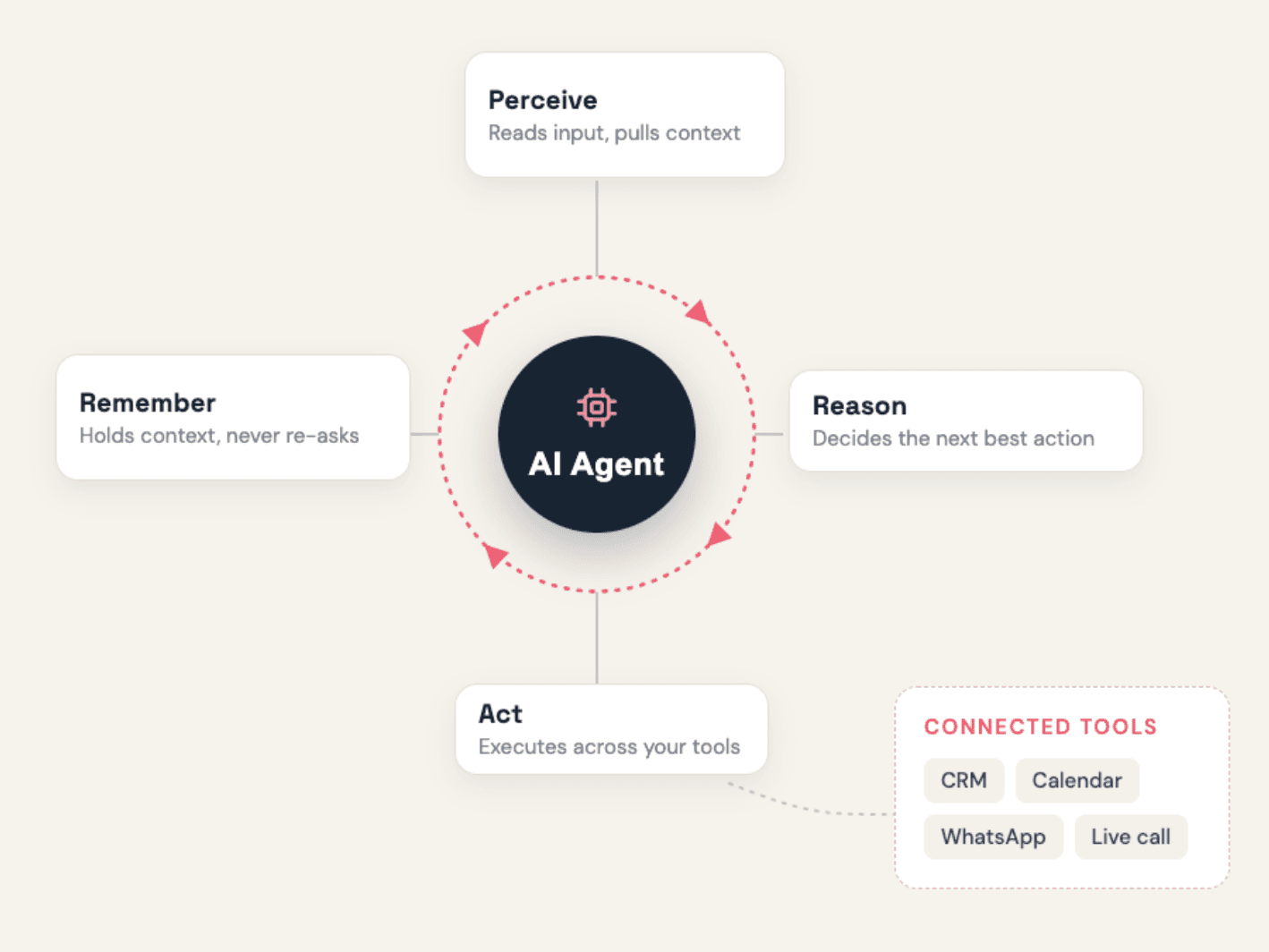
- Perceive. The agent reads the incoming message, email, or call using natural language understanding. It then pulls relevant context from your CRM, calendar, or listing data so it understands the full picture, not just the latest message.
- Reason. The agent works out what the goal requires. Is this lead qualified? Which time slots are free? Does this question need a human? It decides the next best action instead of following a rigid script.
- Act. The agent takes action across your connected systems. It can send a WhatsApp reply, book a calendar slot, update a CRM record, or transfer a live call to a broker, all through integrations with your existing tools.
- Remember. The agent holds context across the whole conversation, so it never asks the same question twice. As you refine its instructions, it gets better at handling your specific situations.
Modern agents are built on large language models for understanding and reasoning, connected to your tools through APIs, with memory to hold context. The model is the brain, and the integrations are the hands. That combination is what lets an agent finish a task from start to end rather than just chatting about it.
AI Agents vs Chatbots vs Traditional Automation
These three terms get mixed up constantly, but they are not the same thing.
| Elements | Traditional Automation | Chatbots | AI Agents |
|---|---|---|---|
How it works | Fixed if-this-then-that rules | Scripted replies to set prompts | Reasons, decides, and acts toward a goal |
Handles | One repetitive task | Simple questions and answers | Multi-step tasks across systems |
Adapts to new situations | No | Limited | Yes |
Example | Sends an email when a form is filled | Answers "what are your office hours" | Qualifies a lead, books a visit, updates the CRM, and alerts a broker |
In short, automation follows rules, chatbots follow scripts, and AI agents pursue outcomes. For a business that wants more booked visits rather than more messages, the difference matters.
Top Roles for Real Estate AI Agents
Voice Assistants for Lead Triage
You can deploy intelligent voice bots to handle initial inbound portal calls. These bots answer the phone instantly at any hour. To see how these systems sound and operate, explore modern AI voice agents that interact naturally with buyers. They ask vital pre-qualification questions about budgets, timelines, and loan pre-approvals. If the lead is hot, the agent transfers the call live to a human broker.
Database Reactivation Managers
Your CRM likely holds hundreds of untouched leads. You can use digital agents to text or call prospects who have sat in your database for over six months. This strategy uncovers hidden conversion opportunities without any manual human effort.
Transaction Document Extractors
Back-office agents handle the tedious paperwork. They read 50-page lease agreements and complex appraisal reports in seconds. The software extracts key dates, rent escalations, and names directly into your property management software.
Property Matchmakers
You can connect an AI agent directly to your Multiple Listing Service (MLS) feed. When a client chats about their dream home, the agent instantly recommends active properties that match their exact criteria.
Appointment and Showing Schedulers
Scheduling is where many deals quietly die. A scheduling agent owns the calendar end to end. It offers available slots, confirms the booking, sends reminders before the visit, and handles rescheduling in a tap. This single role can dramatically cut your no-show rate.
Listing and Content Generators
Feed the agent raw property details and it produces listing copy, social captions, and buyer FAQs in seconds. This clears hours of writing work, though you should always review the output for accuracy and compliance before it goes live.
Market Analysis and Valuation Agents
A valuation agent pulls comparable sales and local data to generate a pricing summary in minutes instead of an hour. Use it during seller consultations to show data-backed numbers on the spot and position yourself as the expert.
Benefits of AI Agents
Eliminate Response Delays - Speed is your ultimate competitive advantage. AI agents for real estate drop response times to under 60 seconds. This ensures every single lead receives an instant, personalized reply.
Reduce Administrative Workload - Stop your human agents from typing endless notes. Let the AI summarize phone calls, transcribe conversations, and log action items directly into the CRM.
Scale Operations Cheaply - Handling triple the lead volume during a new project launch is stressful. AI systems absorb massive inquiry spikes effortlessly. You scale your capacity without hiring extra administrative staff.
How to Get Started with AI Agents
You do not need to rebuild your whole sales process or hire a developer. The smartest path is to start small and expand.
- Pick one high-pain workflow. Choose the gap that costs you the most, such as a slow first response to portal leads or a high no-show rate. Do not try to automate everything at once.
- Map the journey and the rules. Write down what a qualified lead looks like and when a human must step in.
- Choose your channels. Decide where the agent will operate, whether that is WhatsApp, web chat, voice, email, or a mix.
- Connect your data. Link the agent to your CRM, calendar, and listing feed so it can act on real information.
- Set the handoff rules. Define the exact moments the agent passes the conversation to a human.
- Test and refine. Run it on real leads, review the transcripts, and tighten the scripts.
- Expand to the next workflow. Once one role works well, add the next.
The heavy lifting is in the integration and the prompt design, which is exactly where a specialist partner saves you weeks of trial and error.
Build Your AI Agent Tech Stack
Connect the CRM
Your Customer Relationship Management platform is the central brain. You must use robust platforms like Follow Up Boss or kvCORE to house your data. The AI agent relies on this database to make informed decisions. Integrating these systems requires specialized real estate automation architecture to ensure your data moves securely.
Set Up Workflow Automation
Use middleware tools like Zapier or n8n. These tools grant your digital agent permission to move data between your separate apps. This acts as the bridge between your CRM and your communication channels.
Configure the Handoff Protocol
Establish strict rules for when the AI must transfer the conversation to a human. For example, if a buyer asks for a physical tour or negotiates a price, the agent must instantly alert a senior broker.
Limitations and Where AI Agents Fall Short
AI agents are powerful, but they are not magic. Knowing limits keeps you out of trouble.
They cannot replace human judgment in negotiation, complex deals, or emotionally charged moments. A buyer making the biggest purchase of their life still wants a person at the key stages.
They can occasionally get things wrong. An agent may state something inaccurately, so any output involving price, legal terms, or compliance must be reviewed by a human.
They are only as good as the data and rules you give them. Messy CRM data or vague instructions lead to poor results.
And they always need a clean handoff. The point is to let the agent carry the routine load and pass high-value moments to your team at the right time.
Compliance, Data Privacy, and Fair Treatment
Real estate is a regulated industry, and automated communication does not get a free pass.
- Consent and data privacy. Get a clear opt-in before you message a buyer, and handle personal data in line with local rules such as GDPR in the UK and EU, or India's data protection framework. Store data securely and only for as long as you need it.
- Fair and non-discriminatory treatment. In markets like the US, you must not let an agent steer or filter buyers in ways that breach the Fair Housing Act. Keep prompts neutral and inclusive.
- Accuracy of claims. Do not let an agent make guarantees, quote unverified prices, or state legal, RERA, or DLD details it cannot confirm. When in doubt, the agent should hand off to a human.
- Record keeping. Keep call and chat transcripts so you can review quality and prove compliance if questioned.
Common Issues to Avoid
- Maintain Human Oversight - Do not leave your automated systems completely unmonitored. You must review chat and call transcripts weekly. This ensures quality control and helps you refine the agent's scripts.
- Avoid Fragmented Software - Do not use isolated apps that force you to open new browser tabs. Ensure your agent integrates directly with your existing tools. A disconnected tech stack creates more chaos than it solves.
What AI Agents Cost and the ROI to Expect
Cost depends entirely on scope. A single-channel assistant that answers website inquiries is modest. A custom, multi-channel agent connected to your full stack of portals, CRM, and voice costs more to build and run.
The main cost drivers are the number of channels, your message and call volume, the integrations involved, and whether you build in-house or with a partner.
The return shows up in three places. Faster response converts more of the leads you already pay for. Lower admin load frees up staff hours. And the ability to absorb volume spikes means you grow without hiring. The most useful way to judge value is to look at your cost per qualified lead or cost per booking, not the price of the tool on its own.
The Future of AI Agents in Real Estate
The direction of travel is clear. Agents are moving from single tasks toward managing whole workflows end to end. Voice is becoming as natural as chat. Predictive agents are starting to flag likely sellers before they even list, so teams can reach them first. And deep CRM and portal integration is becoming the standard rather than the exception.
Over time, AI agents shift from simply answering questions to running the operational layer of a property business, while humans focus on relationships and closing deals.
Frequently Asked Questions
Will AI agents replace real estate agents?
No. AI agents handle volume, admin, and instant response. Humans handle trust, negotiation, and closing. The strongest teams pair the two.
Are AI agents the same as chatbots?
No. A chatbot follows a script and waits for prompts. An AI agent reasons, decides, and takes action across your tools to complete a task.
Do I need technical skills to use AI agents?
No. The technical work sits in the integration and setup. With the right platform or partner, you can run an agent without writing code.
Can AI agents work on WhatsApp and voice?
Yes. Modern agents operate across web chat, WhatsApp, email, and voice, often at the same time.
Are AI agents safe for handling client data?
Yes, when set up properly with clear consent, secure storage, and human oversight. Compliance should be built in from the start.
How quickly can I get one running?
It depends on the scope. A focused workflow, such as first-response to leads, can go live quickly, while a full multi-channel system takes longer to build and connect.
How Flowlyn Can Help
Building custom AI agents completely on your own requires an immense amount of technical layout time. If an API connection drops or a webhook misfires, you can lose high-value inbound buyers without even noticing.
Flowlyn eliminates this risk. We design, deploy, and maintain custom autonomous systems tailored precisely to your property business.
We connect your lead portals, communication tools, and core CRM platform into a single fluid machine.
Our team handles the complex prompt engineering, data architecture, and technical maintenance. Partnering with Flowlyn ensures your digital sales operate smoothly without adding technical tasks.

About Divyesh Savaliya
Divyesh leads Flowlyn with 12+ years of experience designing AI-driven automation systems for global teams.
In This Article

![Real Estate Chatbot - Benefits & Use Cases [Examples]](/_next/image?url=%2Fimages%2Fblog%2Freal-estate-chatbot%2Freal-estate-chatbot-benefix-use-cases.webp&w=3840&q=75)