Back to Blog
Business Strategy
Benefits of Automation in Accounting - How to Leverage?
Explore the benefits of automation in accounting, including improved accuracy, faster processes, and reduced operational costs.
February 24, 2026
12 min read

The accounting profession is currently navigating a period of profound structural change. Historically characterized by manual ledgers, repetitive data entry, and retrospective reporting, the field is transitioning into a proactive, technology-driven discipline. At the center of this evolution is Accounting Automation, the use of software, Artificial Intelligence (AI), and Robotic Process Automation (RPA) to handle tasks traditionally performed by human accountants.
For the modern enterprise, automation is no longer an optional enhancement; it is a strategic imperative. This transition from manual to automated systems offers a multitude of benefits that extend far beyond simple efficiency, impacting accuracy, compliance, and the overall strategic value of the finance function.
Why Automation Matters in Accounting
Accounting has traditionally been a field marked by rigorous attention to detail, repetitive tasks, and strict deadlines. From data entry and invoice processing to reconciliation and compliance reporting, much of the work is time-consuming and susceptible to human error. Enter automation: software and systems designed to perform routine accounting duties automatically, streamlining workflows and elevating the role of the accountant from data processor to strategic advisor.
At its core, automation in accounting means using technology—such as accounting software, robotic process automation (RPA), and AI-driven tools—to reduce manual intervention in financial operations. This transformation impacts every facet of accounting, yielding tangible benefits that go beyond simply speeding up the work.
Key Benefits of Automation in Accounting
A major time-saver for growing finance teams is implementing AI bank reconciliation to automatically match transactions without the typical manual spreadsheet work.
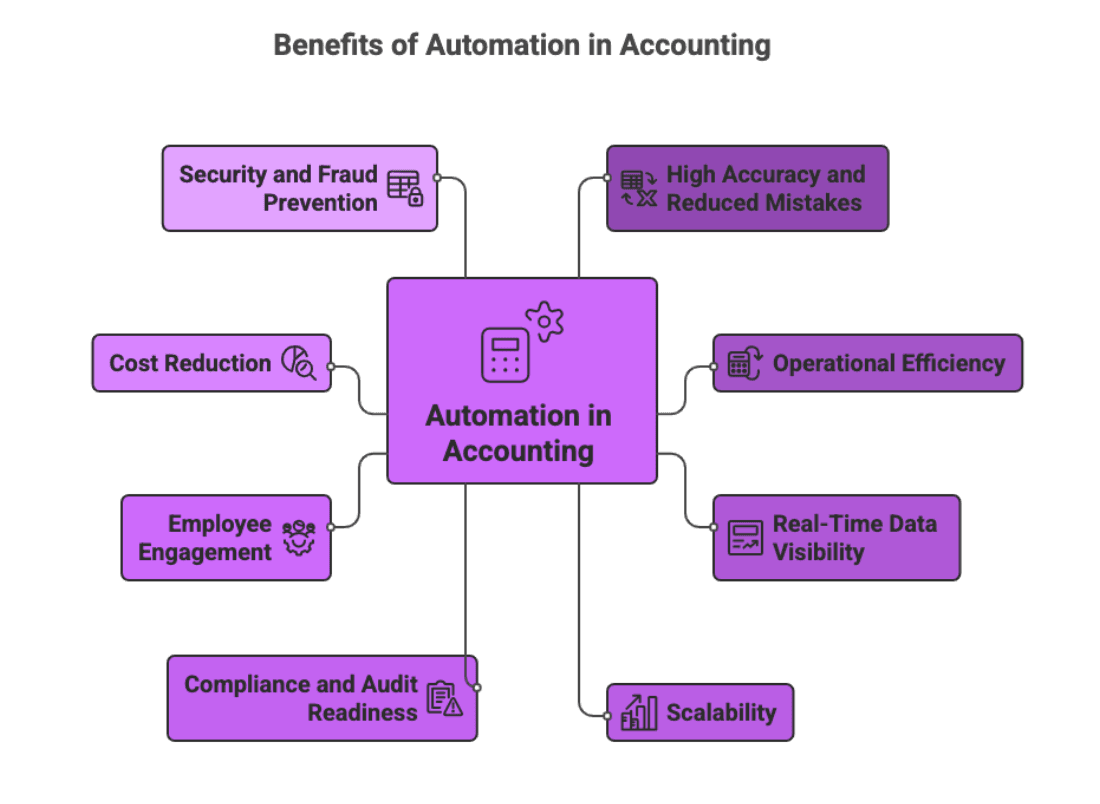
1. High Accuracy and Reduced Mistakes
One of the most immediate benefits of automation is the drastic reduction in human error. In manual accounting environments, the "human element" is often the greatest point of failure. Transposition errors, duplicate entries, and simple typos in a spreadsheet can lead to significant financial discrepancies that take hours to reconcile.
- Data Integrity:Automated systems pull data directly from source documents, such as bank feeds, digital invoices, and point-of-sale systems, using Optical Character Recognition (OCR). By eliminating the need for a human to type figures into a system, the risk of data entry error is virtually neutralized.
- Rule-Based Logic:Automated workflows operate on strict logic. For instance, when an invoice is received, the system can automatically check it against a purchase order and a receiving report (three-way matching). If the figures do not align, the system flags the discrepancy immediately, ensuring that errors are caught at the point of entry rather than weeks later during the month-end close.
2. Exponential Gains in Operational Efficiency
Efficiency in accounting is measured by the speed at which raw data is converted into actionable financial information. Automation compresses this timeline significantly.
- Streamlining the Month-End Close: The month-end close is traditionally a period of high stress and long hours. Automation allows for a "continuous close" model. Since transactions are recorded, categorized, and reconciled in real-time throughout the month, the final closing process becomes a matter of review rather than exhaustive reconstruction.
- Accounts Payable (AP) and Receivable (AR): In AP, automation can handle everything from invoice routing to payment scheduling. In AR, automated systems can send out invoices the moment a product is shipped and follow up with automated reminders for overdue payments. This acceleration of the "order-to-cash" cycle directly improves an organization’s cash flow position.
3. Real-Time Data Visibility and Strategic Insight
Perhaps the most transformative benefit of automation is the shift from retrospective reporting to real-time intelligence.
- From Hindsight to Foresight: Manual accounting provides a "rear-view mirror" perspective; by the time financial statements are prepared, the data is often several weeks old. Automation provides live dashboards that reflect the current financial health of the company. This allows executives to make decisions based on what is happening now, rather than what happened last month.
- Enhanced Business Intelligence (BI): Modern accounting automation tools often integrate with BI platforms. This allows for complex data slicing—analyzing profitability by SKU, region, or customer segment with a single click. When accountants are no longer burdened by data collection, they can devote their expertise to data interpretation, acting as strategic advisors to the business.
4. Scalability Without Proportional Cost
For a growing business, manual accounting presents a significant bottleneck. As transaction volume increases, a manual system requires a linear increase in headcount to keep pace.
- Decoupling Growth from Headcount: Automation allows a finance department to scale its capacity without necessarily increasing its staff. A system that processes 100 invoices a month can often process 1,000 with minimal additional configuration. This allows organizations to maintain lean administrative overhead even during periods of rapid expansion, significantly improving the firm’s operating leverage.
5. Strengthening Compliance and Audit Readiness
In an increasingly regulated global economy, the cost of non-compliance—both in terms of fines and reputational damage—is immense. Automation provides a robust framework for maintaining regulatory standards.
- The Immutable Audit Trail: Automated systems create a digital paper trail for every transaction. Every change, approval, and payment is logged with a timestamp and a user ID. When it comes time for an internal or external audit, instead of searching through physical files or disparate spreadsheets, the accountant can provide auditors with read-only access to a system where every entry is linked to its source documentation.
- Tax Compliance: Tax laws are notoriously complex and subject to frequent change. Automated accounting software often includes tax engines that automatically update to reflect current local, state, and international tax codes. This ensures that the correct amount of sales tax or VAT is collected and that tax liabilities are calculated accurately, reducing the risk of audits and penalties.
6. Improved Employee Engagement and Talent Retention
The "Great Resignation" and the shifting expectations of the workforce have made talent retention a top priority. High-level accounting professionals—often highly educated and analytical—do not want to spend 80% of their time on manual data entry.
Elevating the Role of the Accountant - By automating the "drudge work," firms allow their staff to engage in more meaningful, high-value work, such as:
- Financial modeling and forecasting.
- Risk management and internal controls.
- Strategic tax planning.
- Operational and automation strategy consulting.
When employees feel that their skills are being utilized for strategic purposes rather than clerical tasks, job satisfaction and retention rates typically rise. Automation transforms the accounting department from a "cost center" into a "value center."
7. Cost Reduction and ROI
While the initial implementation of accounting automation software requires a capital investment, the long-term Return on Investment (ROI) is substantial.
- Direct Savings: Reduced need for physical storage, paper, and printing. Significant reduction in labor costs per transaction.
- Indirect Savings: Prevention of costly errors, avoidance of late payment fees through automated scheduling, and the capture of early payment discounts.
Furthermore, the "opportunity cost" of manual accounting is high. The time lost to manual reconciliation is time that could have been spent identifying new revenue streams or optimizing the supply chain.
8. Enhanced Security and Fraud Prevention
Manual processes are inherently susceptible to internal fraud. Forging a signature on a paper check or altering a line item in a manual ledger is far easier than bypassing the sophisticated security protocols of an automated system.
- Segregation of Duties: Automation enforces the "segregation of duties" electronically. The system can be configured so that the person who initiates a payment cannot be the same person who approves it. This creates a digital system of checks and balances that is difficult to circumvent.
- Encryption and Cloud Security: Modern accounting platforms use enterprise-grade encryption and multi-factor authentication (MFA) to protect sensitive financial data. Regular automated backups ensure that even in the event of a hardware failure or a cyber-attack, the organization's financial history remains intact and recoverable.
9. Integration with the Wider Business Ecosystem
Accounting does not exist in a vacuum. It is the language of the entire business. Automation allows for the seamless flow of data between the accounting system and other critical departments.
- ERP Integration: Through APIs (Application Programming Interfaces), accounting software can sync with CRM (Customer Relationship Management) tools, HR systems, and inventory management platforms. For example, when a salesperson closes a deal in the CRM, the accounting system can automatically generate an invoice and update the inventory levels. This "single source of truth" ensures that all departments are working with the same data.
Conclusion: The Path Forward
The transition to automated accounting is more than a technological upgrade; it is a fundamental shift in how businesses manage their most critical asset: financial data. The benefits—ranging from surgical accuracy and real-time visibility to enhanced security and employee satisfaction—create a competitive advantage that is difficult to replicate with manual processes.
As we move further into the decade, the integration of Machine Learning will only deepen these benefits, allowing systems to not only record transactions but to predict future trends with startling accuracy. Organizations that embrace this evolution today will find themselves better equipped to navigate the complexities of the future global market.
Ready to Automate Your Finance Operations?
Contact Flowlyn today to discuss how we can help you implement a scalable, automated accounting ecosystem.
Book Free Call
About Divyesh Savaliya
Divyesh leads Flowlyn with 12+ years of experience designing AI-driven automation systems for global teams.
In This Article