Back to Blog
AI Technology
Marketing Automation Statistics for 2026 - New Report
Explore the most important marketing automation stats; agentic AI adoption, ROI benchmarks, market growth, failure rates, & RevOps data gaps.
We earn commissions when you shop through the links below.
December 18, 2025
8 min read

The marketing landscape in 2025 was not just about automation; it was about autonomy. We are witnessing a fundamental shift from static "if-this-then-that" workflows to Agentic AI — systems capable of reasoning, decision-making, and executing complex goals without constant human oversight.
For decision-makers, the data is clear: while adoption is high (76%), the gap between "having tools" and "generating revenue" is widening. This report breaks down the critical statistics defining the market, the explosive growth of AI agents, and the hidden data pitfalls threatening RevOps success.
Top 5 "Must-Know" Marketing Automation Stats for 2026
If you only take five numbers away from this report, make them these:
- The Rise of Agents: 19.7% of marketers explicitly planned to deploy AI agents in 2025 to automate complex decision-making.
- Budget Surge: 88% of senior executives planned to increase AI-related budgets specifically to fund agentic AI initiatives.
- The Failure Rate: Despite the hype, 42%-54% of organizations scrapped AI initiatives in 2025 due to integration failures and data issues.
- ROI Reality: Businesses are seeing an average return of $5.44 for every $1 spent on marketing automation.
- Data Maturity: Only 16% of RevOps professionals trust their data accuracy, identifying this as the single biggest blocker to automation maturity. (According to Marketingops’s 2025 study)
The Agentic AI Revolution
The most significant trend for 2025 was the move toward autonomous agents. Unlike traditional automation, which requires explicit triggers ("If email opened, then send SMS"), agents work towards a goal.
| Adoption Velocity | Productivity Impact | Strategic Shift |
|---|---|---|
While nearly 20% of marketers are deploying agents now, 79% of companies report that AI agents are already being adopted somewhere within their enterprise. | Two-thirds (66%) of those adopting AI agents report measurable value through increased productivity. | 75% of companies using AI for marketing are shifting human talent toward strategic activities, leaving execution to agents. |
💡
Key Insight:
We are moving from "Task Automation" (scheduling an email) to "Process Automation" (analyzing churn risk, creating a segment, and automatically deploying a retention offer).
Market Dynamics & Financial Impact
Automation is no longer a "nice to have"; it is the financial backbone of modern marketing.
Market Size & Growth
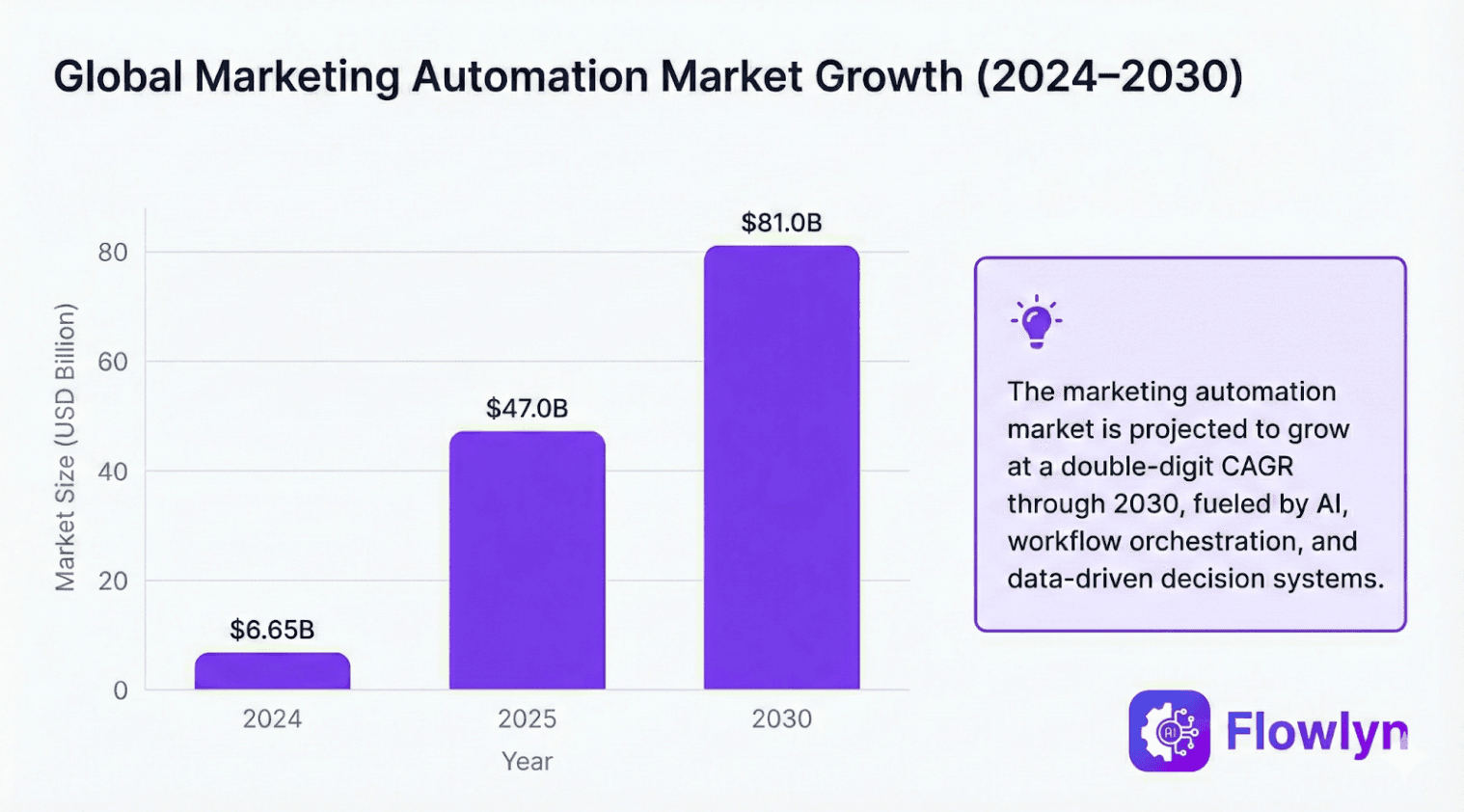
- Total Valuation: The global marketing automation market was valued at approximately $47 billion in 2025 and is projected to reach $81 billion by 2030.
- CAGR: The industry is growing at a Compound Annual Growth Rate of 11.5%.
- SME Growth: Small and Medium Enterprises are the fastest-growing segment, adopting "plug-and-play" AI tools at a 15.2% CAGR.
ROI & Revenue
- Revenue Uplift: Companies using marketing automation software report a 10%+ revenue boost within 6-9 months.
- Lead Generation: Automation generates 80% more leads and a 77% higher conversion rate compared to manual processes.
- Cost Reduction: AI-powered platforms were expected to cut operational costs by 30% by 2025.
Global Adoption & Regional Trends
Adoption maturity varies significantly by region. While North America focuses on optimization and integration (replacement market), APAC represents the highest velocity growth engine for new adoption.
🌐
The "Two-Speed" World
The market is bifurcated into mature regions seeking "suite unification" (NA/EU) and emerging regions seeking "mobile-first" tools (APAC/LATAM).
Here is a snapshot of the current global market dynamics:
LARGEST MARKET
North America
~37% Global Share. High maturity. Focus on CDP integration and legacy system replacement.
FASTEST GROWTH
Asia-Pacific
15.8% CAGR. "Leapfrog" market skipping desktop tools for mobile-centric automation (WeChat/WhatsApp).
PRIVACY FOCUSED
Europe (EMEA)
Strong GDPR Focus. High adoption of privacy-compliant automation and First-Party data tools. 14.60% CAGR, expected in 2025-2030.
EMERGING
Latin America
17.6% CAGR, Rapid marketing automation and adaption growth expected in 2025-2030.
Channel Performance: Where Marketing Automation Wins
Not all channels are equal. In 2025, the highest returns came from channels that support "trigger-based" hyper-personalization.
Email & SMS
Automated flows vs manual campaigns.
| Volume vs. Value | Open Rates | SMS Efficiency |
|---|---|---|
Automated emails represent only 2% of sends but drive 41% of total email orders. | Automated email flows achieve from 25.2% to 42.1% open rates. | SMS marketing has a 98% open rate, with 90% of messages read within 3 minutes. |
Chatbots & Conversational AI
Impact on sales and lead qualification.
| Conversion Power | Lead Qualification | Expectation |
|---|---|---|
AI chatbots are increasing sales by 67% for businesses that deploy them effectively. | Chatbot-led funnels have 400% higher conversion rates. | 72% of customers now expect websites to offer instant messaging support. |
The Infrastructure: RevOps & CDPs
For AI to work, the underlying data must be clean. This has elevated Revenue Operations (RevOps) and Customer Data Platforms (CDPs) to a critical status.
The RevOps Reality
- Companies with aligned RevOps grow revenue 300% faster than non-adopters.
- 75% of RevOps professionals are most frustrated by "data inconsistencies" within their technology stack.
- Aligned RevOps strategies drive 15% higher profitability.
The CDP Boom
- The CDP market is projected to reach $37.11 billion by 2030.
- 88% of consumers trust companies more when they commit to not sharing personal info.
Challenges: Why Projects Fail
Implementing AI and automation is high-risk. The data on failure rates serves as a warning to "strategy-first" adoption.
Project Failure Rates
| 42% | 46% |
|---|---|
Scrapped Projects Abandoned initiatives in 2025 | Proof-of-Concept Failure Never make it to production |
⚠️
The Main Culprit
The primary reason for failure is integration with legacy systems and lack of internal skills.
Industry Benchmarks
| B2B | SaaS | Healthcare | eCommerce |
|---|---|---|---|
98% deem essential. SEO ROI: 748% | Goal: Keep annual churn under 8%. | Rapidly growing. AI adoption up 78% YoY. | Cart Recovery: 1-15% conversion rate. |
Conclusion: The Flowlyn Perspective
The data for 2025 conveys a unified message: Automation is graduating. We are no longer just automating tasks; we are automating intelligence.
For businesses to succeed in 2026, they must:
- Clean the Data: Before deploying an AI agent, invest in a CDP or process optimization audit. Bad data and inefficient workflows kill 42% of projects.
- Focus on Triggers: Move away from "batch-and-blast" to behavior-based triggers (e.g., cart abandonment), which drive 41% of revenue.
- Adopt Agents: Start piloting small-scale AI agents for internal workflows to prepare for the agentic future.While continually seeing these efficiency metrics, many professionals naturally begin to wonder about their long-term employment security, leading to heavy discussion around stats answering will my job be automated?
FAQs About Marketing Automation Statistics
Is marketing automation worth it?
Yes. The data is unequivocal: businesses receive an average $5.44 return for every $1 spent, a 544% ROI.
What ROI can businesses expect?
Beyond the 544% financial ROI, businesses can expect an 80% increase in leads, a 77% increase in conversions, and a 14.5% increase in sales productivity.
How long does automation take to show results?
6 to 9 months. Most companies see positive ROI within the first year, with significant revenue boosts appearing after 6 months of implementation.
Which industries benefit the most?
B2B and eCommerce. B2B sees massive gains in lead qualification (451% increase), while eCommerce relies on it for nearly half (41%) of email revenue. Healthcare is also seeing explosive growth with a 38.5% CAGR.
Sources: [MarketsandMarkets, MarketingLTB, Cropink, Thunderbit, S&P Global, DigitalMarketingInstitute, Inbeat, Grand View Horizon, IMarkGroup]

About Divyesh Savaliya
Divyesh leads Flowlyn with 12+ years of experience designing AI-driven automation systems for global teams.
In This Article