Back to Blog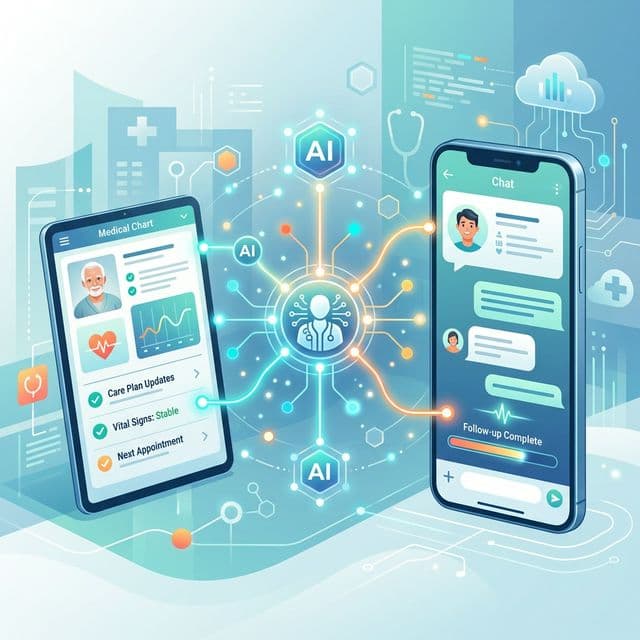
Automation
How to Use AI Agents for Patient Follow-Up?
Learn how AI agents can automate patient follow-ups by sending reminders, collecting feedback, & improving engagement while reducing manual workload.
March 20, 2026
6 min read

The period following a clinical visit or surgery is the most vulnerable time for a patient. Effective follow-up care is essential for preventing complications, reducing readmission rates, and ensuring long-term recovery. However, for many healthcare providers, the manual effort required to call, text, or email every patient is unsustainable. Staff is stretched thin, and vital follow-ups often slip through the cracks, leading to patient leakage and diminished care quality.
The solution isn't to hire more administrative staff; it’s to deploy AI Agents. Unlike simple notification systems, AI agents can engage in two-way conversations, interpret patient responses, and escalate urgent health concerns to medical professionals in real-time. This guide explores how AI agents are transforming patient engagement and how you can build a secure, automated follow-up system using n8n.
5 Powerful Ways to Deploy AI Agents for Patient Follow-Up
Modern AI agents can meet patients where they are, whether that’s on their phone, through a voice call, or via wearable devices.
1. The Conversational SMS Agent (Best for High Engagement)
SMS remains the most effective channel for immediate engagement. An AI-powered SMS agent doesn't just send a "How are you?" text; it uses Natural Language Processing (NLP) to understand the patient's reply. If a patient responds, "I feel okay, but my incision is a bit red," the agent can immediately ask for more details or trigger a specific protocol for wound care.
2. Secure WhatsApp Health Assistant (Best for Global/Visual Care)
In many regions, WhatsApp is the primary communication tool. AI agents on WhatsApp can handle rich media, allowing patients to send photos of their recovery progress or voice notes. Because WhatsApp offers end-to-end encryption, it provides a secure environment for discussing health milestones and sharing visual updates with the care team.
3. AI Voice Agents (Best for Elderly & Accessibility)
For elderly patients or those with visual impairments, typing on a screen can be a barrier. AI voice agents use high-fidelity text-to-speech and speech-to-text to conduct follow-up "calls." These agents can screen for medication adherence and mental well-being by listening for tone and specific keywords, providing a human-like check-in experience without the overhead of a call center.
4. Remote Patient Monitoring (RPM) & Wearable Sync
AI agents can act as a bridge between a patient's wearable device (like a Fitbit or Apple Watch) and the clinician's dashboard. If the agent detects an abnormal spike in heart rate or a significant drop in activity levels over 48 hours, it can automatically reach out to the patient to check on their symptoms before a minor issue becomes an emergency.
5. Multilingual Portal & App Chatbots
Health literacy is a major hurdle in follow-up care. AI agents embedded in patient portals can act as 24/7 medical translators. They can explain post-operative instructions in over 50 languages, ensuring that patients who don't speak the primary language of the clinic still receive clear, accurate guidance on their recovery.
Need a Custom Automation Strategy?
Book a strategic consultation with Flowlyn to streamline your patient engagement.
Book Free CallHow to Build a Patient Follow-Up Agent in n8n
Building a healthcare agent requires a focus on security, timing, and intelligent routing. Here is the technical roadmap for setting this up in n8n.
Step 1: The Secure Ingestion (Trigger)
The workflow begins by pulling patient data from your Electronic Health Record (EHR) or a secure database. Using a Webhook or a PostgreSQL Node, n8n identifies patients who were discharged or seen within a specific timeframe. It is critical that this data is handled within a HIPAA-compliant or secure environment.
Step 2: Scheduling the Engagement Window
You don't want to text a patient at 2:00 AM. Use the Wait Node and Schedule Node to ensure follow-ups occur during respectful hours. You can program the agent to reach out 24 hours after a visit, then again at the 72-hour and 1-week marks, creating a consistent care cadence.
Step 3: Configuring the Agentic Brain
This is the AI Agent Node. You provide the agent with the patient's Discharge Summary as context. The agent’s instruction is to check for specific red flags associated with that patient's procedure. By using models like GPT-4o or Claude, the agent can distinguish between normal post-op soreness and alarming pain levels.
Step 4: Multi-Channel Communication (The Action)
Once the brain decides what to ask, n8n routes the message through the appropriate channel node (e.g., Twilio for SMS, WhatsApp, or Vonage for Voice). If the patient doesn't respond on one channel, the agent can failover to another, ensuring the message gets through.
Step 5: The Escalation & Storage Loop
If the patient reports a high fever or severe symptoms, the agent triggers an Escalation Path. This sends an urgent notification to the nursing staff via Slack or email. Simultaneously, all interactions are logged back into the EHR via an HTTP Request Node, ensuring a complete and legal record of the follow-up care.
Why Healthcare Providers are Switching to n8n
The healthcare industry is rapidly adopting n8n for its flexibility and power. Recent n8n user count statistics show a significant trend toward organizations choosing open-source and self-hosted automation to maintain control over sensitive data. For healthcare providers, the ability to self-host n8n is a decisive factor in meeting strict data privacy regulations.
Ready to Modernize Patient Care?
Book a strategic consultation with Flowlyn to implement automated follow-up workflows.
Book Free CallGet Expert Help for Follow-Up Automation
Automating patient care is a high-stakes endeavor. While the benefits of AI agents, such as reduced staff burnout, better patient outcomes, and increased efficiency, are clear, the technical setup must be flawless to ensure patient safety and data security.
At Flowlyn, we specialize in building robust, agentic workflows that handle complex logic and sensitive data. If you are ready to modernize your patient engagement and move away from manual call lists, we can build a custom solution tailored to your clinical needs. Explore our n8n workflow services to see how we can help you deliver 24/7 care through intelligent automation.

About Divyesh Savaliya
Divyesh leads Flowlyn with 12+ years of experience designing AI-driven automation systems for global teams.
In This Article