Back to Blog
AI Technology
How to Build an AI Email Agent in 2026?
Future-proof your inbox. Learn here how to build an AI email agent in 2026 helping you work faster and smarter.
December 29, 2025
8 min read

Email marketing remains one of the highest ROI channels, but achieving true personalization and scale is a manual, time-consuming challenge.
Enter the AI Email Agent: an autonomous system that uses Large Language Models (LLMs) and tools to analyze customer data, make campaign decisions, and execute complex workflows without constant human supervision.
This guide is designed for marketers ready to move beyond basic automation and embrace the agentic future, detailing the comprehensive steps, tools, and strategic considerations required to build and deploy your own AI Email Agent.
3 Phases to Build an Reliable Email Agent
Here, we will follow 3 phases to build a powerful email agent.
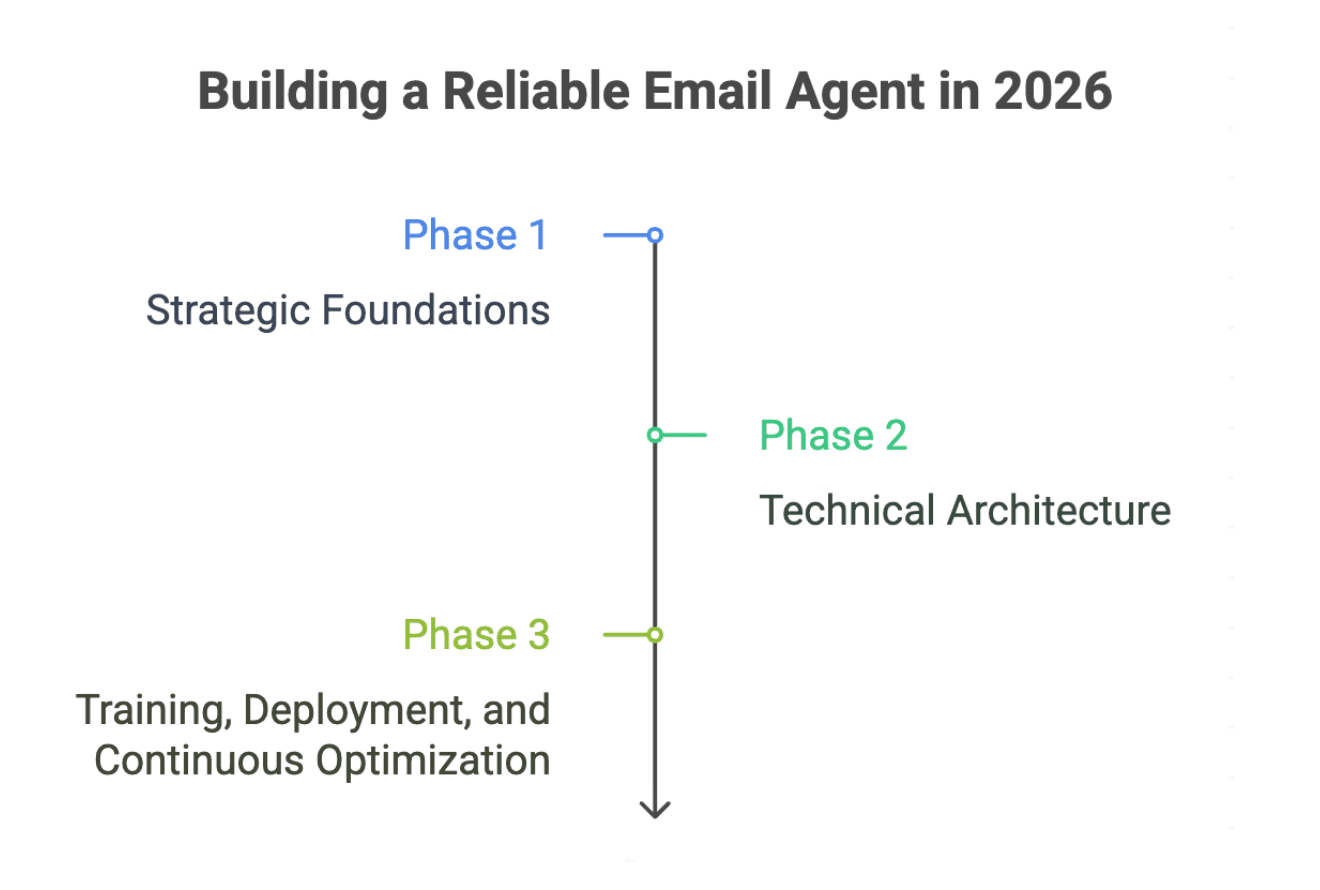
Phase 1: Strategic Foundations
The most common mistake is building an AI solution without a clear, measurable business objective. An AI Agent is not a chatbot; it's a worker designed to achieve a defined goal.
Define the High-Impact Use Case (The "Job to be Done")
Before writing a single line of code (or setting a single prompt), identify the specific, repetitive, high-volume task that, when automated, will significantly impact a key marketing KPI.
Your goal should not be "better email," but something quantifiable like:
- Increase Open Rate: By automating personalized subject line A/B testing across 200 variations.
- Improve Lead Qualification: By analyzing inbound email replies to marketing campaigns and scoring/routing them to sales.
- Boost Cart Recovery: By sending hyper-personalized abandoned cart emails based on the specific items and recent browsing behavior.
Also, identify the stakeholders and users. Will this agent primarily assist the human marketing team or directly interact with customers? Defining the user profile dictates the complexity of the interface and the need for human-in-the-loop checks. If you want a done-for-you solution that handles 90% of your inbox, check out our AI Email Assistant services.
Establish Guardrails, Brand Voice, and Compliance
An agent with autonomy requires boundaries. This initial setup is crucial for protecting your brand and your data.
The agent's core instruction must contain detailed guidelines on tone (e.g., “Always maintain a friendly, professional, but results-driven tone. Never use excessive exclamation marks or emojis.”). This prompt is the Agent's Personality that ensures consistency across all generated copies.
Define explicit rules to prevent the agent from violating data privacy laws or budget constraints (e.g., “Never reveal internal pricing models. Always ensure an unsubscribe link is present.”). This layer acts as the agent's conscience.
Phase 2: Technical Architecture – Building the Core Engine
The AI Email Agent is a complex system composed of several interconnected components, far beyond a simple prompt to ChatGPT.
Select the LLM Brain and Agent Framework
The Large Language Model (LLM) is the agent’s reasoning engine, and the framework is the structure that allows it to use tools and act autonomously.
- State-of-the-Art (e.g., GPT-4, Gemini, Claude): Best for complex reasoning tasks like analyzing a long customer service log to draft a perfectly empathetic reply.
- Optimized Models (e.g., Mistral, fine-tuned smaller models): Ideal for high-volume, repetitive tasks like generating 50 subject lines, where speed and cost-efficiency are paramount.
- For Developers (Python): Frameworks like LangChain, CrewAI, or AutoGen provide maximum flexibility to define the agent's logic, memory, and tool usage. This is necessary for deep customization and integrating proprietary systems.
- For Marketers (No-Code/Low-Code): Platforms like Botpress or Make (formerly Integromat) offer visual builders to define agent workflows (fetch data, reason, take action) without writing Python code, accelerating deployment.
Connect Your Data and Knowledge Base
An agent is only as smart as the data it can access. This step involves implementing Retrieval-Augmented Generation (RAG) to ground the LLM in your proprietary marketing data.
Integrate the agent via APIs to key data hubs:
- CRM (e.g., Salesforce, HubSpot): For customer name, purchase history, lead score.
- Email Platform (e.g., Klaviyo, Mailchimp): For past email performance (opens, clicks), suppression lists, and sending APIs.
- Product Catalog/Knowledge Base: To ensure generated content uses the correct, current product features and pricing.
Transform your marketing data (product descriptions, brand guides, successful email copy) into embeddings (numerical vectors) and store them in a vector database. The agent can then quickly retrieve the most relevant pieces of data to inform its decision-making and content generation, preventing it from "hallucinating" facts.
Implement Actions and Tool-Use Capabilities
The true differentiator of an agent is its ability to act on its decisions by using external tools. The agent must be given the "keys" (API access) to perform marketing functions.
Essential Tools for an AI Email Agent:
- send_email(recipient, subject, body): The core execution tool via the ESP's API.
- update_crm_lead_score(lead_id, new_score): For real-time lead qualification based on email replies.
- query_product_inventory(sku): To ensure a promotional email never advertises an out-of-stock item.
- run_a_b_test_campaign(segment_id, variant_A, variant_B): To autonomously optimize campaign performance.
Tool-Use Logic: The agent's framework must be configured to decide when to use which tool. When given a goal ("Send a follow-up to high-intent leads"), the LLM reasons: “I need the query_crm_leads tool to find the list, the generate_email_copy tool to write the content, and the send_email tool to execute.”
Phase 3: Training, Deployment, and Continuous Optimization
Once the core architecture is built, the focus shifts to refining the agent's performance in a real-world marketing context.
Training and Fine-Tuning the Agent
Initial prompts provide the agent's rules; training refines its style and improves its accuracy.
- Supervised Learning: Feed the agent a dataset of your highest-performing past emails, subject lines, and reply templates, labeled with the segment, goal, and outcome (e.g., "High-converting Welcome Email"). This trains the LLM to understand what "success" looks like in your brand voice.
- Reinforcement Learning from Human Feedback (RLHF): This is the Human-in-the-Loop process. Before mass deployment, all AI-generated copies must be reviewed by a human marketer. Any manual edits or rejections are fed back to the model as negative examples, iteratively improving its performance and reducing off-brand mistakes.
The A/B/n Testing and Real-Time Optimization Loop
The agent's most powerful marketing application is its ability to optimize itself continuously.
- Autonomous A/B/n Testing: The agent can generate hundreds of subject line variations (n) and deploy a test against a small subset of the audience. The agent's LLM then analyzes the real-time open/click data from the ESP's API and, without human intervention, automatically deploys the winning variant to the rest of the list. This accelerated feedback loop is impossible for human teams.
- Send Time Optimization: Using predictive analytics on past recipient behavior, the agent calculates the precise, optimal send time for each individual subscriber, maximizing engagement and breaking the traditional "send time window."
Deployment and Integration
The final step is integrating the agent seamlessly into your existing marketing tech stack.
- API Integration: Ensure the agent's output is directly consumable by your Email Service Provider (ESP) via robust APIs. The agent shouldn't just draft the email; it should set the segment, write the copy, schedule the send, and tag the campaign.
- Monitoring and Analytics: Deploy a dedicated analytics dashboard to monitor the agent's core KPIs (e.g., Deflection Rate, Automated FCR for reply classification, overall campaign ROI). Continuous monitoring is non-negotiable to prevent drift and ensure compliance.
Get Your Free Automation Assessment
Discover how much time and money you can save with custom automation solutions. Our experts will analyze your processes and provide a detailed roadmap.
Get Free AssessmentTrust the Experts of Email Automation
While the journey of building a custom agent is a powerful long-term strategy, the complexities of defining agent logic, integrating multiple APIs, and ensuring strict compliance can create significant development bottlenecks.
If you are ready to stop planning how to build an AI email agent and start experiencing the immediate, transformative benefits of autonomous email management, there is a faster, more reliable path.
Flowlyn's AI Email Assistant service offers an enterprise-grade solution engineered by experts. We handle the complex architecture, RAG integration, and continuous tuning, allowing you to deploy a fully optimized, compliant, and highly effective AI agent into your workflow today.
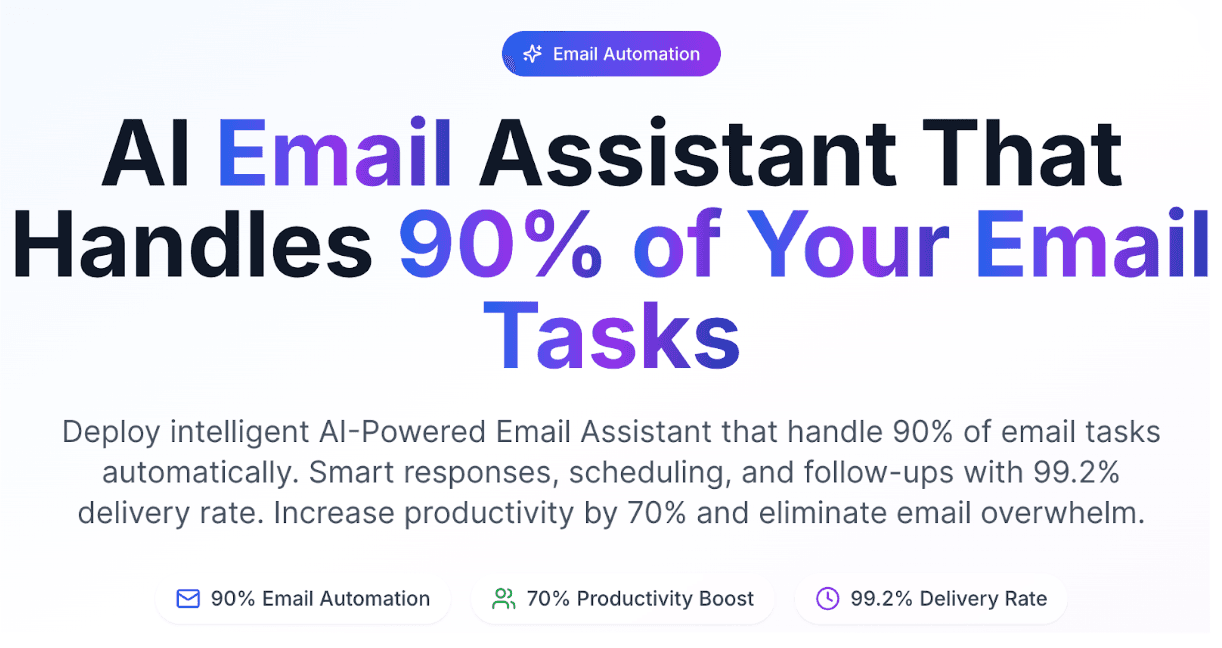
Don't just read about the future of email—start living it.
Explore Flowlyn's AI Email Assistant service today and transform your marketing inbox from a challenging workload into your most powerful, autonomous revenue engine.

About Divyesh Savaliya
Divyesh leads Flowlyn with 12+ years of experience designing AI-driven automation systems for global teams.
In This Article