Back to Blog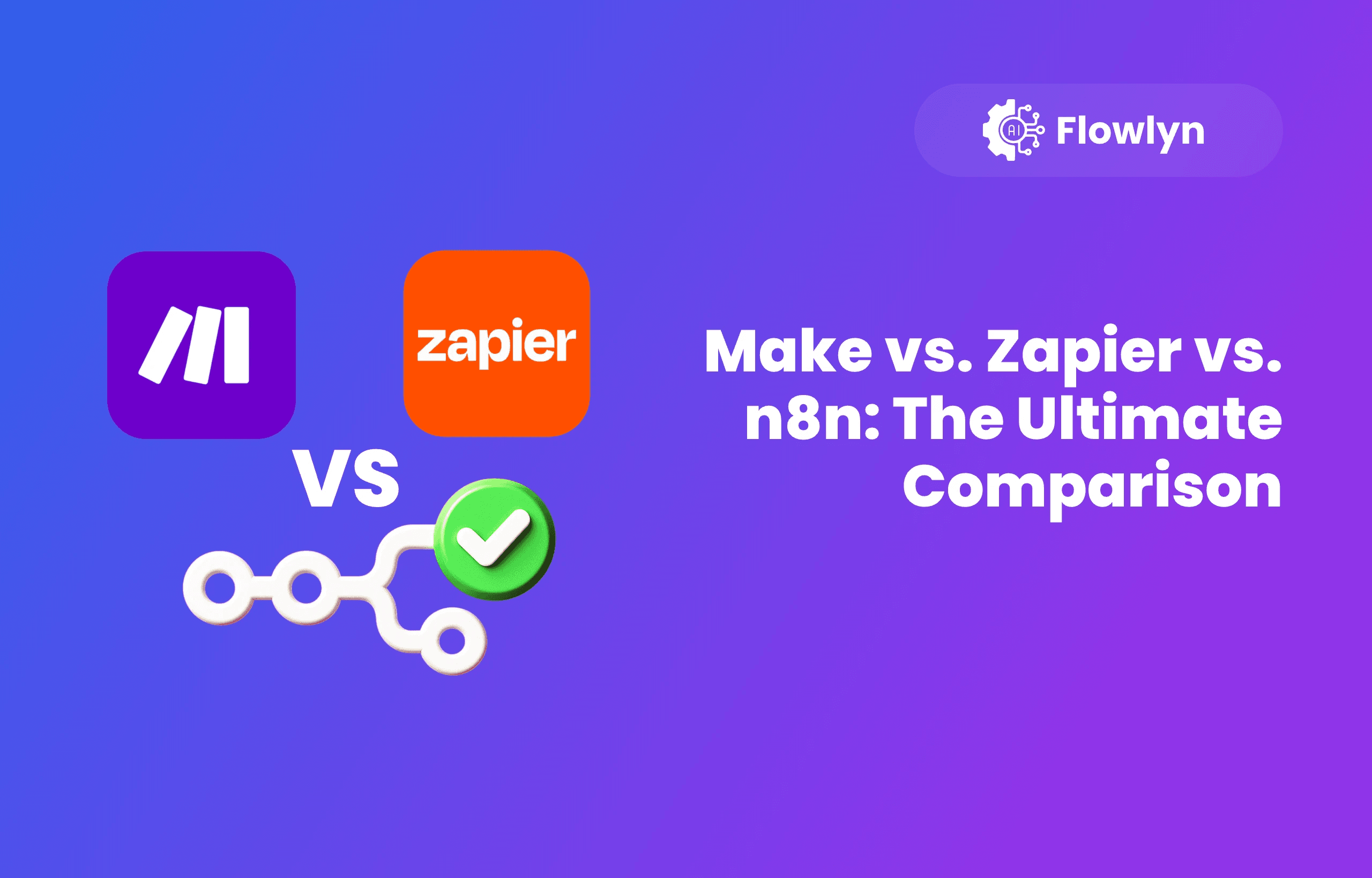
Tools & Platforms
Make vs. Zapier vs. n8n: The Ultimate Comparison
Here is a detailed Make vs. Zapier vs.n8n comparison to discover which workflow automation tool fits your budget, technical skill, and more.
We earn commissions when you shop through the links below.
January 23, 2026
12 min read

It's a big debate on Reddit: Make vs. Zapier vs. n8n - hundreds of threads, thousands of opinions.
But which platform should you really choose in 2026?
Let's compare them side-by-side to see.
Comparison Matrix
| Feature | Zapier | Make.com | n8n |
|---|---|---|---|
Philosophy | "It just works" | Visual logic & data flow | Developer power & control |
Ease of Use | Very High (No-code) | Moderate (Visual canvas) | Moderate-High (Technical) |
Integrations | 8,000+ | 2,000+ | 400+ built-in & almost anything via API |
Pricing Unit | Per Task (Action) | Per Operation (Module) | Per Execution (Full Run) |
Self-Hosting | No (Cloud-only) | No (Cloud-only) | Yes (Free & Unlimited) |
AI Focus | Built-in Agents/Chat | Visual AI Canvas | LangChain & Vector DBs |
What Do They Actually Do?
1. Zapier | The Accessibility Leader
Zapier remains the accessibility leader in 2026. If you need to connect two obscure SaaS tools in under five minutes, Zapier is unbeatable. Its primary strength lies in its massive ecosystem and its "set it and forget it" managed infrastructure.
With a library of over 8,000+ integrations, it is the only platform that guarantees connectivity for virtually every niche app on the market. This allows you to build AI agents that "watch" your docs and spreadsheets to learn your business logic, executing actions across your tech stack via simple conversation.
2. Make.com | The Visual Architect
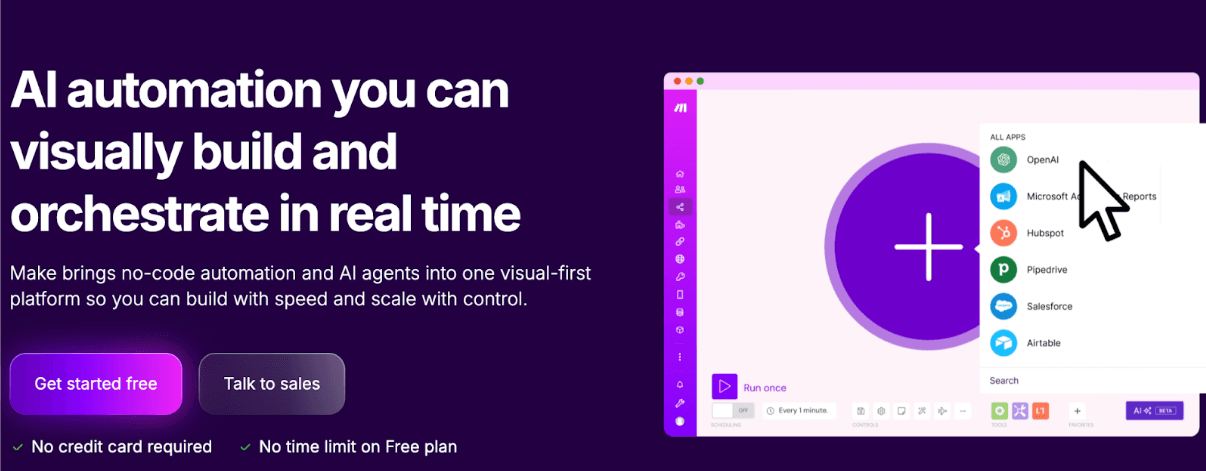
Make (formerly Integromat) occupies the sweet spot between Zapier's simplicity and n8n's technical depth. Its flowchart-style interface allows you to see exactly how data transforms as it moves through your "Scenario."
Make bridges the gap between simple triggers and technical depth with a beautiful, flowchart-style interface. Unlike linear lists, Make uses a canvas that lets you build and see complex branching, filtering, and error-handling paths in real-time. Explore how Make’s workflow automation works.
3. n8n: The Developer's Powerhouse
n8n is the disruptor in the space with 3000+ enterprises. By offering a fair-code license, it allows you to self-host the entire platform on your own servers. In 2026, it has become the gold standard for teams building AI-native workflows and those requiring total data sovereignty This aligns with the rise of thousands of commercial 'agentic systems'.
While Zapier charges for every single step, n8n Cloud charges per workflow run. If you self-host, your cost is $0 regardless of how many millions of tasks you run. It leads the pack with native LangChain integration, allowing you to build multi-agent systems, connect vector databases, and run local LLMs (via Ollama) directly.
The Pricing Comparison
Understanding how Zapier, Make, and n8n count "work" is critical for long-term scalability. While a tool might look cheap at 100 runs per month, the math changes drastically when you hit 10,000.
Zapier: Per-Task Model
A "task" is counted every time a single action is successfully completed. If your workflow (a "Zap") triggers once and performs 5 actions (e.g., searches a CRM, filters a lead, updates a row, sends a Slack, and creates a calendar event), that is 5 tasks.
- The Math: A 10-step workflow running 1,000 times = 10,000 tasks.
- The Risk: As you add "quality of life" steps to your Zaps like data formatting or additional notifications your monthly bill increases linearly, which can lead to "pricing shock" as your business grows.
Make: Per-Operation Billing
Functional-wise, this is almost identical to Zapier's "tasks," but with a major caveat: every module execution counts. If your visual flow branches into three different paths, but only one path is taken, you are only charged for the active path.
- The Math: Similar to Zapier, a 10-step scenario running 1,000 times = 10,000 operations.
- The Benefit: While the unit counting is similar to Zapier, Make's entry-level plans are significantly more generous, often providing 10,000 operations for the same price Zapier charges for 750 tasks.
n8n: Execution-Based Model
An "execution" is one full run of a workflow from start to finish, regardless of how many steps are inside. You could have a 2-node workflow or a 200-node AI-powered agent; if it runs once, it counts as one execution.
- The Math: A 10-step workflow running 1,000 times = 1,000 executions.
- The Power: This model actively encourages you to build complex, high-value workflows without the anxiety of watching a meter run for every single data transformation.
For high-volume data processing (like syncing thousands of CRM records or daily database cleanups), n8n is often 10x to 50x cheaper than Zapier. Many companies use Zapier for simple "one-off" triggers but migrate their heavy-lifting, multi-step logic to n8n workflow to save thousands in annual overhead.
Data Privacy & Security
Zapier and Make are purely cloud-based (SaaS) platforms.
This means that every time a workflow runs, your data—whether it's customer emails, financial records, or proprietary AI prompts—must travel to and be processed on their servers.
- They maintain SOC 2 Type II and SOC 3 certifications, follow ISO 27001 standards, and are fully GDPR compliant.
- However, for organizations in "high-stakes" sectors, these platforms cannot offer a true air-gapped environment.
n8n is the primary choice for teams that treat data sovereignty as a non-negotiable requirement. Because n8n allows for self-hosting via Docker or on-premise servers, the entire automation engine sits behind your company firewall.
- When you self-host n8n, your data never leaves your infrastructure. If you are a healthcare provider processing Protected Health Information (PHI), you can maintain HIPAA compliance with much greater ease because the "processor" is your own secure server, not a third-party vendor.
- This architecture is ideal for GDPR (ensuring data residency within specific borders) and proprietary AI development.
Zapier and Make offer a "security-as-a-service" model where they shoulder the burden of updates and protection, making them perfect for 90% of business use cases.
However, n8n provides the remaining 10%—the high-security, highly regulated, and AI-sensitive industries—with a way to automate at scale without ever compromising the "air gap" between their data and the outside world.
Which One Should You Choose?
Choosing the right platform in 2026 is no longer about finding the tool with the most features, as all three leaders now offer robust AI capabilities and deep integration libraries. Instead, the decision should be driven by your volume economics and technical resources.
- Zapier remains the undisputed king of speed and accessibility; it is the best choice for teams without developers who need to launch simple, reliable automations in minutes.
- Make.com is the ideal "middle ground," offering a powerful visual canvas for those who need complex logic and transparency without the high price tag of per-task billing.
- n8n is the strategic choice for technical teams and high-growth startups; its execution-based pricing and self-hosting options provide the ultimate path to data sovereignty and cost-efficiency at scale.
By aligning your automation tool with your specific growth trajectory, you ensure that your technology stack remains an asset rather than a growing liability.
Need help choosing the right automation platform?
Contact Us to discuss your automation strategy and find the perfect fit for your business.
Book Free Call
About Divyesh Savaliya
Divyesh leads Flowlyn with 12+ years of experience designing AI-driven automation systems for global teams.
In This Article