Back to Blog
Automation
How to Build a Scalable Automation Strategy in 2026
Learn how to build a scalable automation strategy step by step: from auditing your processes to deploying n8n workflows that grow with your business.
February 25, 2026
12 min read

Most businesses automate backwards. They spot a painful task, grab a tool, and wire something together — only to find six months later that they have 30 disconnected Zaps, three overlapping platforms, and no one who truly owns any of it.
A scalable automation strategy flips that pattern. It starts with structure, not software. This guide walks you through exactly how to build one from your first process audit to a fully managed n8n infrastructure that grows with your business.
Top Reasons Most Automation Efforts Fail to Scale
Automation fails to scale for one consistent reason: it was built for a single problem, not a system. Here are some common reasons why most automation efforts fail in early stages:
- 1. Lack of Clear Strategy & Vision: Without a well-defined automation roadmap aligned to business outcomes, teams build isolated or tactical automations that don’t scale across functions.
- 2. Starting with Complex Processes First: Jumping into automating highly complex or poorly understood processes often leads to failures — because foundational stability is missing.
- 3. Poor Process Standardization: If the underlying manual processes are inconsistent or undocumented, automations break easily when variations occur.
- 4. Inadequate Leadership Buy-In: Without executive support and investment, automation programs struggle for resources, budget, governance, and cross-team coordination.
- 5. Underestimating Change Management: People resist change. When stakeholders aren’t trained, engaged, or incentivized, automation adoption stalls and initiatives fail to scale.
- 6. Siloed Teams & Fragmented Ownership: When automation efforts live inside individual teams instead of across business units, duplication, poor governance, and bottlenecks emerge.
- 7. Lack of a Reusable Automation Framework: Without reusable components, common libraries, standards, and templates, each new automation is reinvented — causing inefficiency and inconsistency.
- 8. Insufficient Tech & Infrastructure Readiness: Scaling automation requires stable systems, APIs, integration platforms, and data quality — lacking these leads to brittle solutions.
- 9. No Measurement or KPIs for Value: Teams often automate without defining how success will be measured (ROI, cycle time, error rates), making it hard to track impact or justify expansion.
- 10. Weak Governance & Risk Control: Automation often fails when there’s no governance around design standards, security, compliance, or lifecycle management.
- 11. Poor Vendor or Tool Selection: Choosing tools without considering long-term scalability, integration support, or total cost of ownership causes roadblocks later in the journey.
- 12. Ignoring Post-Deployment Support: Automation isn’t “set and forget.” Without ongoing monitoring, maintenance, and continuous improvement, bots fail and confidence drops.
- 13. Talent Gaps & Skill Shortages: Lack of skilled automation engineers, architects, and business analysts slows development, increases errors, and prevents scaling.
- 14. Over-automation & Misalignment with Human Needs: Trying to automate everything without understanding where humans add value leads to wasted effort and resistance from users.
- 15. Inadequate Data Quality & Accessibility: Automation depends on reliable data. Inconsistent, siloed, or inaccessible data destroys scalability and accuracy.
A scalable strategy treats automation as infrastructure, not a collection of shortcuts. Before picking any tool, you need a clear picture of your processes, your data flows, and your growth trajectory. Understanding how workflow automation works end-to-end is the foundation every strategy must be built on.
Steps to Build a Scalable Automation Strategy in 2026
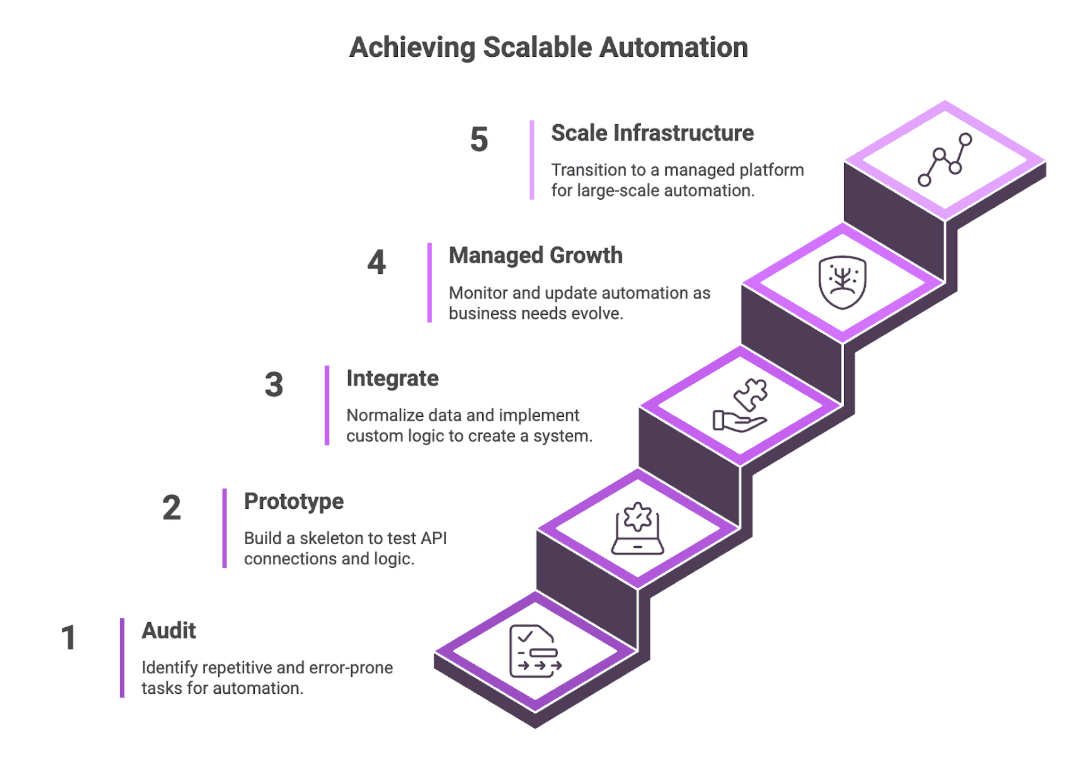
Step 1: Audit Your Processes
The first move in any scalable automation strategy is a structured process audit. Go department by department and document every recurring task. For each one, ask three questions: Is it rule-based? Is it high-volume? Does it consume skilled time that could be spent elsewhere?
Tasks that answer yes to all three are your Tier 1 automation candidates — the highest-ROI starting points. Tasks that require judgment calls or creative input should stay human-led, at least for now.
Use Flowlyn's automation ROI calculator to rank candidates by financial impact and prioritize ruthlessly. Trying to automate everything at once is one of the most costly workflow automation mistakes businesses make. If you want an expert to build your roadmap for you, explore our automation strategy consulting services.
Step 2: Design the Architecture
Once you know what to automate, you need to decide how your automation stack will be structured. This is the step most businesses skip — and it is exactly why their automations don't scale.
A proper automation architecture has three layers:
- The Orchestration Layer: This is the brain. A central workflow engine connects your apps, manages logic, and passes data between systems. For most businesses in 2026, n8n is the strongest choice here. It is open-source, self-hostable, handles complex branching logic, and supports custom JavaScript transformations that no-code tools cannot match. If you are currently on Zapier and hitting its limits, the Make vs. Zapier vs. n8n comparison will help you evaluate the switch.
- The Integration Layer: This is where your individual apps — CRM, ERP, email platform, helpdesk — connect into the orchestration layer. Every integration should be documented, version-controlled, and built with error handling from day one. An undocumented integration is a future outage waiting to happen.
- The Intelligence Layer: This means embedding conversational AI into customer-facing workflows, using AI agents to process unstructured inputs like emails and documents you can look at various AI agents examples for inspiration—and routing decisions that previously required human judgment.
Step 3: Start Small, Validate Fast
A scalable strategy does not mean a big strategy on day one. It means building in a way that can grow. Start with one high-impact workflow: a lead routing automation, an invoice processing pipeline, or a customer onboarding sequence and get it running cleanly in production.
The goal of this first workflow is not just the time saved. It is proof of concept for your architecture. Does data flow cleanly between systems? Are errors caught and logged? Can the workflow handle 10x the current volume without breaking? If yes, your foundation is solid. If not, fix it now before it is buried under 40 more workflows.
For businesses automating their sales pipeline, AI-driven lead generation and conversational AI for lead qualification are consistently the highest-ROI starting points, delivering measurable pipeline impact within weeks.
Step 4: Build for Observability & Error Recovery
The difference between a fragile automation and a scalable one is not the tool — it is the error handling. Every workflow in a scalable strategy must have three things built in from the start:
| Element | What It Does | Why It Matters |
|---|---|---|
Error Logging | Records failed executions with full context | Enables fast debugging without manual investigation |
Retry Logic | Re-attempts failed steps automatically | Handles transient API failures without human intervention |
Alerting | Notifies the right person when something breaks | Prevents silent failures from snowballing |
n8n handles all three natively — error trigger nodes, retry configuration, and webhook-based alerting are built into the platform. When Flowlyn manages an n8n deployment, this observability layer is configured as standard from day one, not bolted on later.
Step 5: Scale With a Managed n8n Infrastructure
The final step is the one that separates businesses with 5 workflows from businesses with 500. Scaling automation requires moving from self-managed tools to a managed automation infrastructure — where the platform is hosted, monitored, updated, and optimized by specialists so your team can focus on building, not maintaining.
This is where Flowlyn's n8n workflow services become the operational backbone.
Flowlyn manages the hosting environment — choosing the right server configuration for your n8n instance, handling security patching, managing execution logs, and refactoring workflows as your data volumes grow. For businesses processing sensitive data, a self-hosted managed deployment also solves GDPR compliance — your data never leaves your private server.
Real-world results from this approach: a real estate agency scaled to 300% more qualified leads and an e-commerce operator reduced fulfillment time by 95% through automated order processing.
Your Scalable Automation Strategy: The Roadmap
If constructing an internal team feels daunting, you might want to consider automation as a service to outsource your infrastructure setup and execution entirely.
| Phase | Focus | Timeline |
|---|---|---|
1. Audit | Map processes, identify Tier 1 candidates | Week 1–2 |
2. Architect | Design orchestration, integration, and intelligence layers | Week 2–3 |
3. Build & Validate | Deploy first workflow, stress-test the foundation | Week 3–5 |
4. Instrument | Add error logging, retry logic, and alerting | Week 5–6 |
5. Scale | Managed n8n infrastructure, expand to new departments | Ongoing |
The Audit and Architect phases are where the strategic heavy lifting happens. Instead of just picking a random task to automate, you identify "Tier 1" candidates—those high-volume, high-friction processes that offer the quickest ROI. The Architect phase then ensures that your tools don't just "talk" to each other, but do so through a centralized intelligence layer that can handle complex data transformations and logic.
During Build and Instrument, the focus shifts from "does it work?" to "will it stay working?" Phase 3 is about the Proof of Concept (PoC) and initial deployment to ensure the logic holds up under real-world data. Phase 4, however, is the most critical for long-term success; by building in error logging and retry logic, you ensure that a temporary API flicker doesn't break your entire business process.
The final Scale phase represents the transition to a managed environment. This often involves moving to robust infrastructure, like a managed n8n instance, which can handle increased execution volume across multiple departments. At this point, automation is no longer a project but a core utility of the company, constantly expanding as new inefficiencies are identified and eliminated.
Final Words
A scalable automation strategy is not about how many tools you use — it is about how deliberately you build. Audit first. Architect before you code. Instrument for failure. And when you are ready to scale past what a solo tool can handle, move to a managed infrastructure that grows with you.
Flowlyn has guided 500+ businesses through exactly this process — from their first automated workflow to a fully managed n8n environment running across every department. Book a free strategy call and get a custom automation roadmap built for your business within days.
Ready to Transform Your Operations?
Contact Flowlyn today to discuss how we can help you build a scalable automation strategy.
Book Free Call
About Divyesh Savaliya
Divyesh leads Flowlyn with 12+ years of experience designing AI-driven automation systems for global teams.
In This Article